AI-Native Series · Agent Engineering · Loop Engineering in Practice
AI PR Review That Cannot Lie
Evidence per claim, "unmeasured" over silent, and a path envelope for auto-merge. A build report from a repo where human review had become the bottleneck, written for the co-founder who asked for it and for anyone about to hand a merge button to a model.
1-minute takeaway — what you'll walk away with
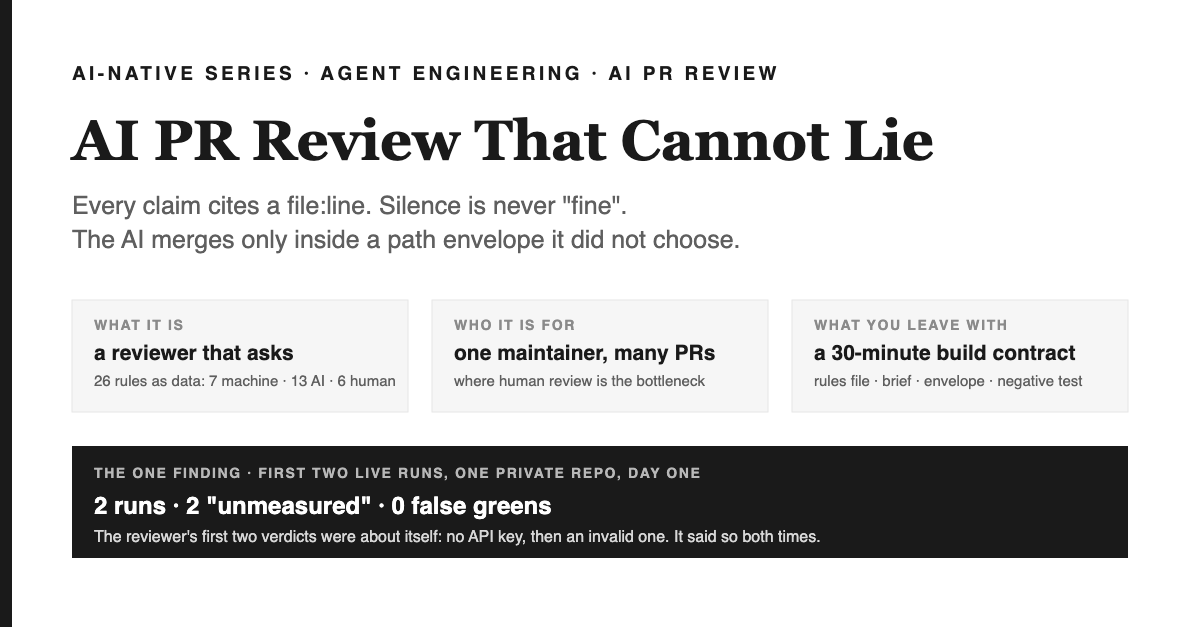
What this is. A build report on an AI PR review for a manufacturing quality-management codebase where one maintainer had merged every PR and no PR had ever received a review. The model reads each pull request and posts one brief. It is not allowed to approve on its own judgment, it is not allowed to make a claim without a file and line number, and it is not allowed to be silent when it could not run.
Why it matters. For an engineer, an AI reviewer that can invent a finding, or stay quiet when it failed, is worse than no reviewer: it teaches the team to ignore it. For a founder, "auto-merge" is a blast-radius decision, not a model-quality decision, and this design puts the blast radius in a data file the model cannot edit. For a student, it is a worked example of the one habit that separates a gate from a decoration: making it go red on purpose before trusting its green.
What you can do after reading. Copy the shape in thirty minutes: a rules file with three tiers (machine, AI, human), an eight-section brief with an evidence filter, a path envelope with deny-wins semantics, five AND-ed conditions for auto-merge, and a negative test you run before calling any of it live. The section Build it in 30 minutes is the contract; the day-one section is what it looks like when the contract holds under a bad key.
What this report covers, and why an AI PR review needs a different design
This is a report on one week of work. A team I co-build with named "PR review by a human" as the single bottleneck to iteration speed, and assigned me two same-day items: deploy an automatic reviewer on the repository, and write down the review standard it enforces. The repository is a quality-management system (QMS) for factories, where every record may later be pulled as evidence in a customer audit. That raises the stakes for review in a specific way: a merged bug is not a bug, it is a false record.
The design question is not "can a model review code". Models review code well enough to be useful. The question is what an AI PR review must be forbidden from doing so that a team keeps trusting it after the tenth PR. My answer is four prohibitions and one envelope, and the whole article is those five things with their evidence:
- The reviewer may not make a claim without a
file:linecitation. Unbacked claims are dropped, and the number dropped is printed on the brief. - The reviewer may not be silent. No key, a model refusal, an API error: each produces a posted comment that says "unmeasured" and "this is not 'no problem'".
- The reviewer may not re-judge what scripts already decided. Tenant isolation, secrets, migrations, foreign keys, bilingual docs, tests, and the golden case library are attached to the brief verbatim from the scripts that computed them.
- The reviewer may not leave the human-only list empty without saying why. "Nothing for a human to judge" must come with its reason, or the absence reads as "the reviewer did not run".
- The reviewer may only trigger a merge inside a path envelope it did not choose, and only as one of five AND-ed conditions.
Readers: AI engineers who run one maintainer and many agents; founders who need to decide what "auto-merge" may touch; and students who want to see how a gate is made honest rather than merely installed. The analogy comes after the problem, and it is one picture from one domain: a restaurant kitchen with three passes before a plate leaves.
The bottleneck, measured before anything was built
Before proposing a reviewer I pulled the repository's own numbers, because "review is slow" and "review does not exist" need different fixes. Twenty-four merged PRs. Twenty-four authored by the same person. Twenty-three merged by their author. Zero review records on the eight PRs I sampled. Nine open PRs from other contributors, all with zero reviews, the oldest waiting sixteen days. The median merge time of six minutes in the history was not fast review; it was an author merging themself.
Two more facts shaped the design. The CI had silently failed for eleven days the previous month, every job dying in two seconds with zero steps because the account's Actions minutes had run out, and nobody had noticed because red-with-no-steps looks the same as red-with-a-failure from a distance. And the repository was a free private plan, which meant no branch protection at all: any green or red PR could be merged by anyone, and the only thing preventing it was memory.
Google's study of its own practice analysed logs for nine million reviewed changes [5]; a practice that has run zero times produces no such logs, and no such learning. So the actual situation was a review process that had never run once, about to receive nine external PRs through a single person, on a repository with no enforcement layer. A reviewer that occasionally hallucinated a finding, or occasionally failed quietly, would land on a team with no habit of checking. That is why the prohibitions come before the prompt.
The mental model: three passes in a restaurant kitchen
One picture carries the design, and it is the kitchen on the cooking ladder, at the "running a restaurant" rung. A plate leaves a serious kitchen through three passes, and the passes are different in kind, not in strictness.
| In the kitchen | In the repository |
|---|---|
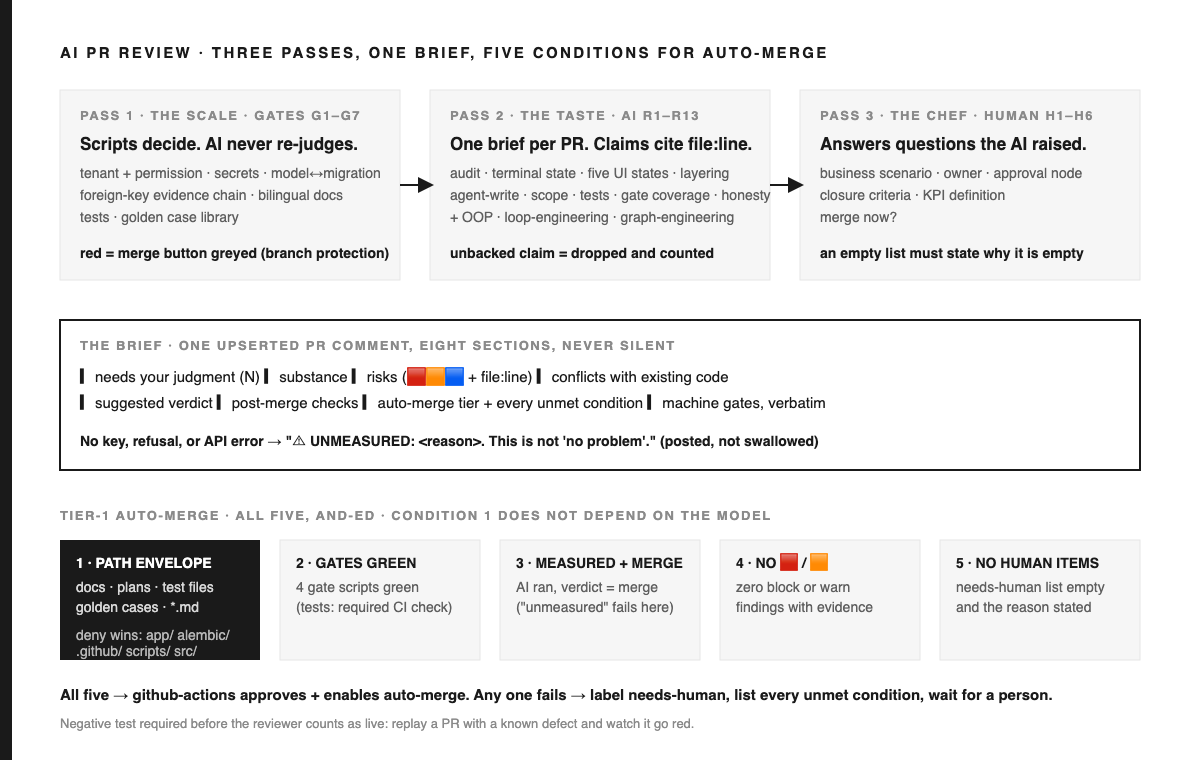
| The scale, the thermometer, the ticket check. A scale does not have opinions. Under weight, the dish does not leave, whoever cooked it. | Machine gates G1–G7. Scripts that already exist: tenant-and-permission AST check, secret-shape scan, model-to-migration pairing, foreign-key evidence chain, bilingual doc pairing, tests, golden case library. Red greys the merge button under branch protection. |
| The sous-chef tastes the sauce and writes a note: "salt is high on the third ladle; whether it goes out tonight is yours." The note points at a ladle, not a mood. | AI pre-review R1–R13. One brief per PR. Every finding cites file:line. It asks the questions only a person can answer and suggests a verdict it cannot enforce. |
| The chef reads the note, tastes that one spoonful, and says out or not. | Human-only H1–H6. Business scenario, responsible person, approval node, closure criteria, KPI definition, merge now. A code owner answers only what the brief raised. |
| Cold starters and dressings the sous-chef has tasted go out without the chef, because a wrong dressing is a remake, not a refund. | Tier-1 auto-merge. Docs, plans, test files, golden cases: low blast radius by path. The bot approves and enables auto-merge when four more conditions hold. |
| The hot line waits for the chef. Always. The sous-chef never says "send it" on a steak, however sure they are. | Application code, migrations, CI, scripts, frontend source are never in the envelope. The AI's opinion of them is input, never a trigger. |
The reason a kitchen works this way is the reason the reviewer works this way. The moment the sous-chef's note becomes the thing that sends plates, cooks start cooking for the note. The moment an AI verdict becomes the merge condition, contributors start writing PRs that satisfy the AI. Keeping the note as a note, and the scale as the scale, is what keeps both honest.
The mechanism: four things the reviewer is not allowed to do
1. No claim without a file and a line
The model returns structured output constrained by a JSON schema [4]: a list of findings, each with a rule id, a severity, a claim, and an evidence array. Before anything is rendered, a filter walks every finding and keeps only evidence strings matching path:line where the path is either in the PR's changed files or exists in the repository at that commit. A finding with no surviving evidence is removed, and a counter increments. The brief ends with the line "N claims without file:line evidence were dropped".
Two details matter. The path may point at a file the PR did not touch, because "this conflicts with existing code" is exactly the kind of finding whose evidence lives in an old file; restricting evidence to the diff would delete the most valuable category. And the count is printed, not hidden, because a reviewer that quietly discards half its own output is telling you something about its calibration that you want to see.
The system prompt says this in one sentence: claims without evidence will be discarded by the system, so say less rather than invent. The filter is what makes that sentence true rather than hopeful.
2. Unmeasured is a posted state, never silence
The first version of the brief, when there was no API key, printed the machine-gate results and nothing else. It looked like a reviewer with no objections. That is the most dangerous output a reviewer can produce, because from the outside "I found nothing" and "I did not run" are the same comment.
The fix is a branch that cannot be skipped. If there is no credential, if the model returns a refusal stop reason, if the API raises, or if the structured output fails to parse, the brief renders a section headed "unmeasured" with the exact reason, followed by the sentence "this is not 'no problem'", followed by the machine gates and a note that every human-only item now needs a human. The workflow still posts it. A unit test pins each of those phrases, so a refactor cannot quietly restore the silent version.
3. Machine gates are attached, not re-judged
Seven gates exist, G1 to G7: an AST pass over routers for tenant filtering and permission dependencies; a secret-shape scanner over added lines that reports positions and never echoes values; model-to-migration pairing; a foreign-key gate over every *_id column; bilingual documentation pairing; the test suites; and a golden case library where deterministic modules must reproduce their standard outputs. The reviewer itself runs the four scripts that decide six of them, because the submission-gate script covers secrets, migration pairing and bilingual docs in one pass; the seventh, the test suites, runs in its own CI jobs and the reviewer does not repeat it. So a brief shows four script lines under "machine gates", and those four lines cover G1 to G5 and G7. The reviewer records pass or fail with the last six lines of output and hands the result to the model with the instruction: these are decided, do not re-decide them.
The reason is not that the model would get them wrong. It is that a second opinion on a deterministic check is noise, and noise on a brief is what makes people stop reading briefs. The most cited field study of modern code review, at Microsoft, found that reviewers spend their effort on understanding rather than on defect-hunting, and put it this way in the abstract:
"Our study reveals that while finding defects remains the main motivation for review, reviews are less about defects than expected and instead provide additional benefits such as knowledge transfer, increased team awareness, and creation of alternative solutions to problems."
— Bacchelli and Bird, ICSE 2013, author's copy [6]
If human reviewers are mostly building understanding, then an AI brief that repeats a scale reading is spending the reader's attention on the one thing a script already settled. The model's attention goes where scripts cannot reach: whether a closing action writes an audit record, whether a create endpoint can reach a terminal state, whether a router is doing business logic, whether the PR description's claims have pasted evidence.
4. An empty human-only list must say why
The brief's first section is "needs your judgment", and it is the only section a code owner has to read. When it is empty, the model must fill a companion field with the reason, and the renderer prints "empty; reason: …". Without that, an empty section is indistinguishable from a model that never considered the question. This is the same principle as prohibition two applied at a finer grain: absence is never allowed to carry meaning.
Rules as data, and three principles that became rules
The 26 rules live in one JSON file, not in the prompt and not in the documentation. Each rule has an id, a tier, a title, what to check, which gate or person decides it, and the source it was derived from. The documentation page's table is generated from the file by a --render-rules command, and a --check-doc command in CI fails if the table in the document differs by a character from what the file renders. The prompt receives the same rendered table. Three consumers, one source, no drift.
Seven rules are machine tier and each names the script that decides it; a test asserts those scripts exist, because this repository had earlier documented a secret scanner that had never been written. Six are human tier, lifted from the project's own 15-item module checklist: the items that ask "what real factory problem does this solve" cannot be answered from a diff. Thirteen are AI tier. Ten of them are the checkable residue of the project's engineering laws: audit records on critical actions, terminal states unreachable from create endpoints, five UI states, router-only-orchestrates, human-signs-every-AI-reachable-write, single concern, implementation log present, tests for changed pure logic, gate coverage, and description-matches-evidence.
The last three were added because my co-founder asked for review "according to our OOP, loop-engineering and graph-engineering principles", and a principle that lives only in a conversation is not a rule. So:
| Rule | What the reviewer checks |
|---|---|
| R11 OOP | One responsibility per new class or function; reuse of the existing domain and closed-loop layers instead of copies; business rules written as pure functions that can be tested without a database; routers only orchestrate. |
| R12 Loop engineering | Every new gate, rule, or automation ships with a way to make it go red on purpose; state machines have terminal states and a rollback; any judgment can be re-run with one command; "unmeasured" is counted separately from "passed". |
| R13 Graph engineering | Every new *_id declares a foreign key; cross-module effects (complaint to supplier corrective action, SPC violation to process issue, return to root cause) go through the closed-loop hooks rather than being written inline; any record can be traced back to its source document and its responsible person. |
R12 is the article's own rule applied to itself, which is why the next two sections exist.
The envelope: paths decide, not confidence
The team's request was that PRs which meet the bar merge without a person in the way. The earlier design said the AI must never be a merge condition. Both are right about something, and the resolution is not a compromise between them; it is a different variable. The question "should the AI's verdict cause a merge" has a bad answer in both directions. The question "where is the blast radius low enough that a wrong merge is a remake rather than a refund" has a data answer.
The envelope is two lists of path prefixes in the rules file. Allowed: documentation, plans, the golden case files, test directories, and anything ending in .md. Denied, and deny wins over allow: the workflow directory, the scripts directory, the application package, the migrations, frontend source, the Makefile, and the two agent-guide files. A Markdown file under the workflow directory is denied. A test file under the application package is denied. The model does not see this list as a choice; it is applied after the model has answered.
Tier-1 then requires five things at once: every changed path inside the envelope; every gate script green (the four lines on the brief; G6, the test suites, is a required status check that GitHub's auto-merge itself waits on); the AI review measured with a verdict of merge; zero findings at block or warn severity (a third level, info, is shown on the brief but never affects the tier); and an empty human-only list. When all five hold, the workflow approves the PR as the Actions identity and enables GitHub's auto-merge, so the merge fires when the required checks finish. When any fails, the PR gets a "needs human" label and the brief lists every unmet condition, not just the first. That last point came from a unit test: the first implementation returned early on the first failure, which means a contributor would fix "path outside envelope", re-run, and only then learn about the warn-level finding. Three reasons should print as three reasons.
Two GitHub settings make the bot's approval count: the repository must allow Actions to approve pull requests [3], and branch protection [1] must not require the approval to come from a code owner, because the Actions identity is not one. Auto-merge itself is GitHub's feature [2]; the workflow only enables it. The code-owners file still routes review requests to people. The protection script defaults to one required approval with the code-owner requirement off, and prints both repository settings back after applying, because a free plan silently ignores the auto-merge setting and a script that does not read back is a script that lies.
Day one: the reviewer's first two verdicts were about itself
The workflow shipped in a PR, and that PR was the first thing it reviewed. There was no API key in the repository yet. The brief said so: "unmeasured: ANTHROPIC_API_KEY missing (repository secret not configured). This is not 'no problem'." Below it, the four gate scripts, all green, and the tier line: needs human, because the changed paths included the workflow and the scripts directory, and because the AI review was unmeasured.
My co-founder added the secret. The next PR, the one adding the envelope, was the second thing it reviewed. The brief said: "unmeasured: AuthenticationError 401, invalid x-api-key." Same tier line, same two reasons, plus a third: the key the platform had been given was not a key the platform accepted.
I am recording this as the day-one result rather than as an embarrassment because it is the design under its intended load. A reviewer that had stayed quiet on both runs would have produced two PRs that looked reviewed and were not. Instead, two PRs carried an explicit statement that the AI had not run, why, and what that meant for the human. The mechanism did not merge either of them on its own; both were outside the envelope, and the second condition failed anyway. Zero false greens is the number; the scope is two runs, one repository, one day.
There was a second silent failure on the same day, one layer down. Branch protection is a paid feature on private repositories, and the upgrade had been purchased. The API answered a paid upgrade with a 403 for ten straight minutes of polling, and the auto-merge setting patched back as false. The protection script exits non-zero with the upgrade URL when that happens; it does not pretend. The account-level cause is still being diagnosed as this is written, which is the honest status of the last condition, and it is on the page rather than in a footnote for the same reason the brief posts "unmeasured".
Patterns, anti-patterns, and the first principle
Patterns that held. Evidence as a schema field, filtered by existence, with the drop count printed. Failure states rendered as sections, never as absence. Deterministic checks attached from their scripts, not re-derived by the model. Rules in one data file rendered into the prompt and the documentation by the same function, with a drift check in CI. Blast radius expressed as path prefixes with deny-wins, applied after the model has answered. Every unmet condition listed, not just the first.
Anti-patterns this replaced. A reviewer that approves. A brief that omits a section to mean "no issue". A confidence score standing in for a citation. A rule that lives in a prompt and a second copy in a document. A silent skip when the credential is missing. An early return that reports one reason when three are true. Each of these looked like a reasonable first draft and each would have made the reviewer easier to ignore by the tenth PR.
The first principle, in one sentence. A review signal is only worth reading if its absence and its failure are both visible, and its claims can be checked without trusting it; everything else in this article is that sentence applied to a merge button.
Build it in 30 minutes
This is the contract, not the code. The code is repository-specific; the contract transfers. Thirty minutes is the budget the contract sets for a reader who copies the table into a fresh repository; it is not a time I measured. The shell here was written in one sitting, and the tests, the two documents and the day-one runs took the rest of the day.
| Element | Specification |
|---|---|
| Inputs | The PR's diff against the merge base, ordered by risk (application code first) and capped by characters, with every omitted file listed by name on the brief. The PR title and body. The pass/fail and last six output lines of each existing machine gate. The rules table rendered from the rules file. |
| Output | A structured object: needs_human[] with rule, question, why; needs_human_empty_reason; substance; risks[] and conflicts[] with rule, severity in {block, warn, info}, claim, evidence[]; verdict in {merge, hold, request_changes}; verdict_reason; post_merge_checks[]; global_notes[]. Rendered as one Markdown comment in eight sections (needs your judgment, substance, risks, conflicts, verdict, post-merge checks, auto-merge tier, machine gates) with a hidden marker so re-runs edit rather than append. |
| Invariant | Every rendered finding has at least one evidence string matching path:line whose path exists. The brief is posted on every run, including failed ones. Machine gate results appear verbatim. An empty human list carries a reason. |
| Stop rule | The model is called once per PR event. There is no retry loop on refusal or parse failure; those become "unmeasured". The job continues on error so a reviewer outage is visible but never blocks a merge. |
| Minimal schema | A rules file: {id, level ∈ {block, ai, human}, title, check, gate, source} (the machine tier is spelled block in the file, after what it does to the merge button) plus auto_merge: {allow_prefixes, allow_suffixes, deny_prefixes}. That is the whole configuration surface. |
| The CI threshold | Auto-merge fires only on all five conditions. The doc-drift check (--check-doc) is a required static gate. The reviewer's own job is not a required check. |
| Deliberately missing | No retry, no second model as judge, no confidence scores (a finding is either evidenced or dropped), no per-rule weighting, no learning from past PRs. Each is a place where the first version would have gained cleverness and lost auditability. |
| The negative test | Before calling it live: replay a PR with a known defect. In this repository, the candidate is the fix that stopped a create endpoint from accepting a closed status directly; reverting its three code files must produce a block-level R2 finding pointing at the router. A reviewer that does not go red on that does not count as live. This run is pending the valid key. |
# The whole loop, from a PR event
diff, omitted   = collect_diff(merge_base, changed_files)      # risk-ordered, capped, omissions listed
gates           = run_machine_gates(base)                       # scripts decide; last 6 lines kept
review          = call_model(meta, files, diff, gates, rules)   # structured output, one call, no retry
review, dropped = filter_findings(review, files)                # path:line or it is gone; count kept
tier, reasons   = classify_tier(brief, envelope)                # five conditions, all reasons listed
brief           = render_brief(...)                             # never silent; unmeasured is a section
post_comment(pr, brief); apply_tier(pr, tier)                   # upsert; approve + auto-merge only on tier-1
Same story, five exits
| Reader | The one decision | The one action |
|---|---|---|
| Student | A gate is only a gate after you have seen it red. | Take any checker you rely on, break the thing it checks on purpose, and confirm it fails. If it does not, you have a decoration. |
| Engineer | Evidence is a schema constraint, not a prompt request. | Add an evidence[] field to your reviewer's output, filter on path:line existence, and print the drop count. |
| Founder | Auto-merge is a blast-radius decision; put the radius in a data file. | Write the allow and deny path lists before you write the prompt, and make deny win. |
| Executive | "Review exists" and "review has run" are different claims; measure the second. | Ask for the count of PRs with zero review records, and the count of reviewer runs that reported "unmeasured". |
| Investor | The team that shows you its reviewer going red on a planted defect has a review process; the team that shows you green has a screenshot. | Ask to see the negative test. |
What is measured, and what is not yet
- Measured. Fourteen unit tests pin the evidence filter, the unmeasured rendering, the envelope's deny-wins semantics, the five-condition tier logic and its cumulative reasons, and the doc-drift check. Two live runs on real PRs produced two "unmeasured" briefs and zero silent outputs. Both PRs were classified needs-human for listed reasons.
- Not yet measured. The negative test (a planted defect producing a block-level finding) is open as a PR and will run once a valid key is present; until it goes red, the reviewer is installed but not live by its own rule. The Tier-1 positive path (a docs-only PR approved and merged by the bot) is blocked on branch protection, which is blocked on an account-level plan issue. No numbers exist yet for precision of AI findings on real code; the evidence filter is a floor, not a measurement.
- Illustrative. The kitchen. It maps one-to-one and it is not data.
Read next
Part of the AI-Native Series · Agent Engineering. Numbers in this article are scoped where they appear; the kitchen is a model, not a measurement. The rules file, the reviewer, the workflow, the protection script and the tests described here exist in a private repository; the shapes are reproduced in full above so that nothing depends on access to it.
References
- GitHub Docs. About protected branches. docs.github.com — required status checks, required reviews, and the plan availability of protection on private repositories.
- GitHub Docs. Automatically merging a pull request. docs.github.com — the auto-merge behaviour Tier-1 relies on.
- GitHub Docs. Managing GitHub Actions settings for a repository. docs.github.com — the setting that lets a workflow approve a pull request.
- Anthropic. Structured outputs. docs.anthropic.com — the schema-constrained response the evidence filter operates on.
- Sadowski, C., Söderberg, E., Church, L., Sipko, M., Bacchelli, A. (2018). Modern Code Review: A Case Study at Google. ICSE-SEIP, DOI 10.1145/3183519.3183525. research.google · author's copy (PDF) — described, not quoted: 12 interviews, a 44-respondent survey, and review logs for 9 million reviewed changes.
- Bacchelli, A., Bird, C. (2013). Expectations, Outcomes, and Challenges of Modern Code Review. ICSE 2013. author's copy (PDF) — the quotation above is from the abstract of this copy, checked word for word against the PDF; the version of record at IEEE may differ in typography.